
⚡ TL;DR - QUICK ANSWER
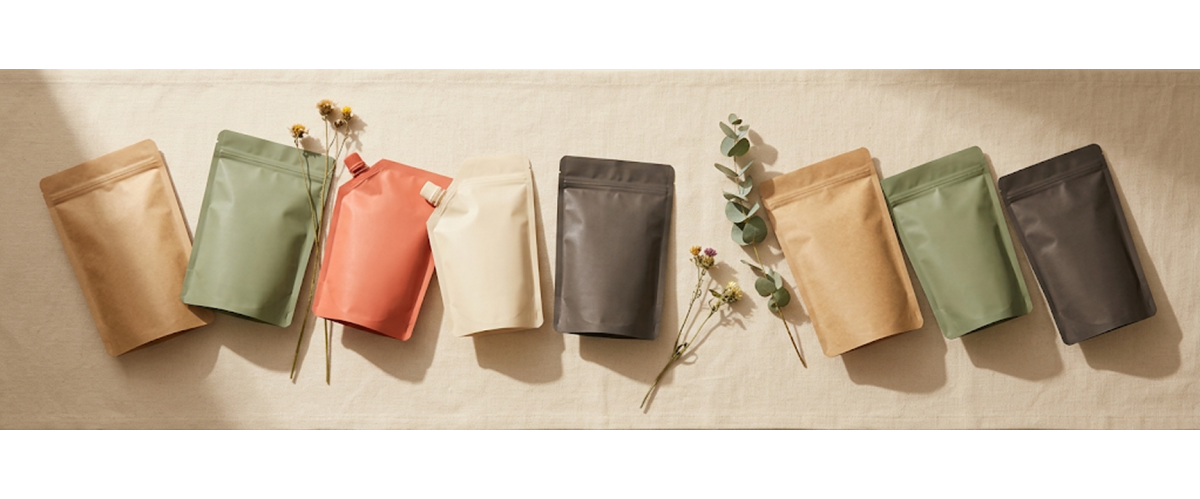
The 12 best sustainable packaging companies in 2026 are WildKind Packaging, TIPA, Elevate Packaging, Footprint, Sealed Air (Plantic), Notpla, Sourceful, Packhelp, EcoEnclose, Noissue, Genpak, and Lush Vault. Each leads in a different cut of the market — from BPI-certified or TÜV-certified compostable flexible pouches to molded fiber alternatives (Footprint) to seaweed-based films (Notpla). The right one for you depends on your vertical, MOQ, and end-of-life claim.
Contents
- What makes a packaging company actually sustainable?
- How we evaluated each company
- Best for compostable flexible pouches (coffee, snacks, supplements, pet)
- Best for molded fiber rigids (foodservice, secondary packaging)
- Best for e-commerce shipping packaging
- Best for materials innovation (early adopters)
- Best for closed-loop reusable packaging
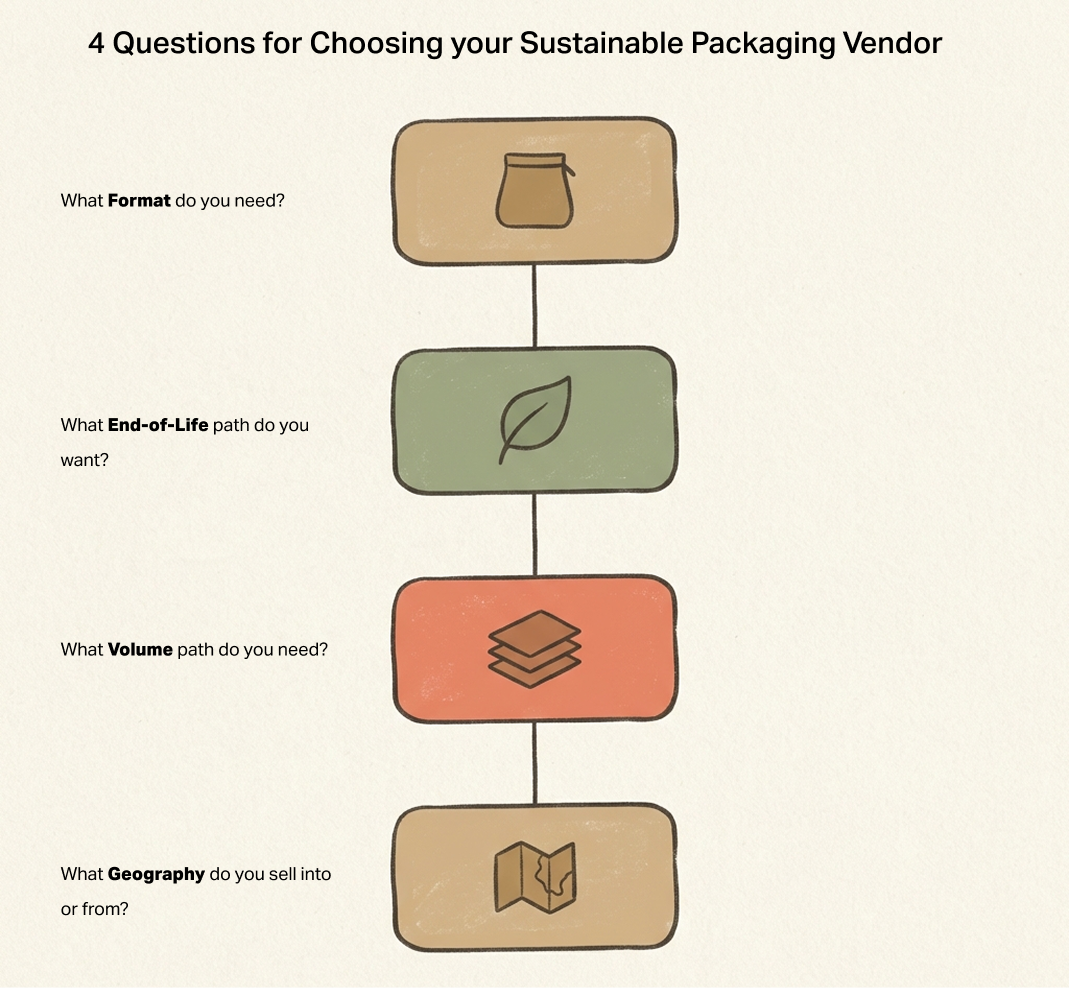
- How to choose between them — a 4-question framework
- What changed from 2025 to 2026
- Frequently Asked Questions
- The bottom line on the best sustainable packaging companies in 2026
I. What makes a packaging company actually sustainable?
Not all "sustainable" packaging is created equal — and the FTC has been increasingly explicit about which claims hold up. Truly sustainable packaging meets at least three of four criteria: it uses renewable or recycled inputs, it has a credible end-of-life path (compost, recycle, reuse), it has a third-party certification verifying that path, and it's produced with measurably lower lifecycle emissions than the conventional alternative.
The 12 companies on this list each meet that bar in a different way. Some lead with materials science (TIPA’s certified compostable films, Notpla's seaweed films, Footprint's molded fiber). Some lead with certifications (WildKind, TIPA, Elevate all use certified materials). Some lead with operational scale (Sealed Air, Genpak). The "best" depends entirely on what your brand is trying to ship in.
II. How we evaluated each company
Five factors, weighted equally: materials credibility, third-party certifications (BPI, TÜV OK Home or Industrial Compost, ASTM D6400/D6868 standards, FSC, How2Recycle), MOQs and accessibility, vertical fit, and geographic reach. We pulled certification claims directly from BPI's verified database and each company's public materials specs. Where a company makes a marketing claim we couldn't verify, we noted it. Yes — including for ourselves.
The 12 best sustainable packaging companies in 2026
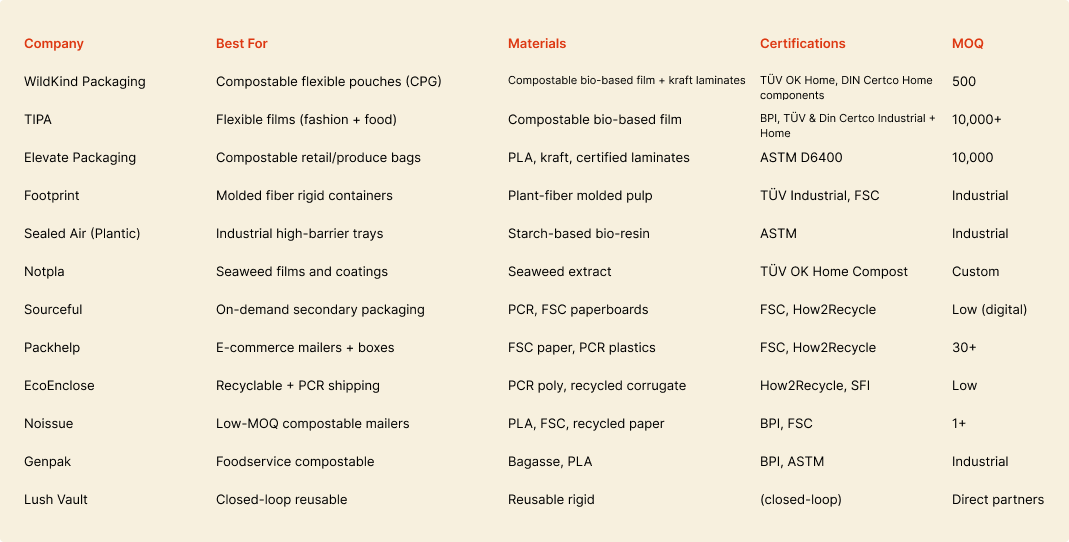
WildKind appears in row 1 because the article's organizing logic leads with compostable flexible specialists, not because of vendor rank. Rows 2–12 follow descending volume capability and category specialization.
III. Best for compostable flexible pouches (coffee, snacks, supplements, pet)
If you ship a CPG product in a flexible pouch and you want compostable, the shortlist narrows to three: WildKind Packaging, TIPA, and Elevate Packaging.
WildKind is best for brands ordering 500–500,000 units per SKU per year, who need custom-printed pouches in 10-20 business days (+shipping time), and who care about domestic Austin, Texas manufacturing for EPR-compliance and lead-time reasons. TIPA is a proud partner of WildKind helping with both industrial AND home-compostable certified films. Elevate is best for retail produce bags or compostable shipping bags.
IV. Best for molded fiber rigids (foodservice, secondary packaging)
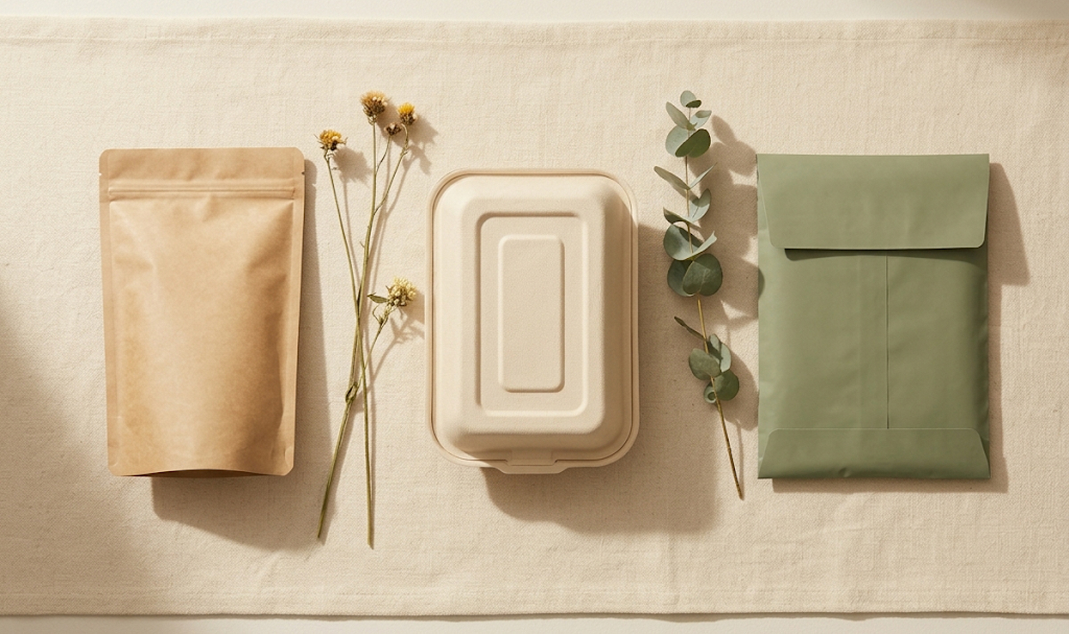
Footprint dominates this category. They lead with engineering — their rigid pulp containers have replaced plastic in foodservice clamshells, microwaveable trays, and beverage cups for major chains. Not for low-MOQ brands; their book of business is industrial. Genpak is the credible alternative at restaurant scale.
V. Best for e-commerce shipping packaging
EcoEnclose is the workhorse for North American e-commerce brands. Strong PCR poly mailers, fast turnaround, How2Recycle certified. Noissue wins on low MOQ (1+ units) and is the right call for early-stage Shopify brands. Packhelp is the EU equivalent with strong North American presence.
VI. Best for materials innovation (early adopters)
Notpla is the most exciting materials-science play in the category — seaweed-based films and coatings that home-compost in 4–6 weeks. They're not yet at the volume or pricing for most CPG brands, but if you're an early adopter looking to lead a category, watch them closely.
VII. Best for closed-loop reusable packaging
Lush's Vault program is the model for closed-loop reuse — customers return empty containers in exchange for refills or product credit. Most brands can't replicate the model at scale, but it's the right answer for product categories with high frequency-of-purchase.
VIII. How to choose between them — a 4-question framework
Question 1 — Format: Flexible (stand-up pouch, flat pouch, mailer)? Rigid (bottle, jar, container)? Or secondary (mailer box, void fill, tissue)? This alone eliminates 6–8 of the 12 companies for any given project.
Question 2 — End-of-life path: Are you committing to compostable, recyclable (with PCR content), or reusable (closed-loop)? FTC Green Guides require that your label match the actual end-of-life infrastructure available to your customer.
Question 3 — Volume: Sub-1,000 units = e-comm specialists (Noissue, Packhelp). 500–500,000 = compostable flexible specialists (WildKind, TIPA, Elevate). 500,000+ = industrial (Footprint, Sealed Air, Genpak).
Question 4 — Geographic priority: Domestic manufacturing matters more in 2026 than it did in 2023 because of EPR fees, container shipping volatility, and retailer Scope 3 emissions reporting.
IX. What changed from 2025 to 2026
1. EPR is no longer theoretical. California SB 54, Oregon's Plastic Pollution and Recycling Modernization Act, and Colorado's HB22-1355 all have producer fee structures landing in 2026.
2. Home-compostable certification is becoming the differentiator. Industrial-only certifications (BPI, ASTM D6400) remain table-stakes. Premium shelf placement is increasingly going to brands with TÜV OK Home Compost.
3. Retailer Scope 3 reporting is forcing CPG brands to switch. Walmart's Project Gigaton, Target's preferred chemicals program, and Whole Foods' packaging standards are pulling brands into compostable conversations.
X. Frequently Asked Questions
- Which sustainable packaging companies are BPI certified?
The Biodegradable Products Institute maintains a public database at bpiworld.org. Among the companies on this list, TIPA and Genpak each have BPI-certified products in their compostable lines. BPI certification means the product meets ASTM D6400 or D6868 standards for industrial compostability. - What's the lowest MOQ for sustainable packaging?
For compostable flexible pouches with custom printing, WildKind starts at 500 pieces per SKU for standard or 5,000 units for custom sizes. For e-commerce mailers, Noissue starts at 1 unit (digital print). For rigid foodservice, Footprint and Genpak typically require industrial volumes. - How much does sustainable packaging cost compared to plastic?
Compostable flexible pouches typically run 10–30% above conventional plastic at comparable volumes in 2026, down from 40–60% in 2022 as bio-resin scale has improved. PCR-content recyclable packaging runs 5–15% above virgin plastic. - Is "compostable" the same as "biodegradable"?
No — and the FTC's Green Guides are explicit on this. Biodegradable means the material will eventually break down into natural elements; "eventually" can mean decades. Compostable means the material breaks down into non-toxic biomass within a defined timeframe under specific conditions. - Are there sustainable packaging companies for small batches?
Yes — Noissue (1+ units), Packhelp (30+ units), and Sourceful (digital MOQ on secondary packaging) all serve very small brands. For compostable flexible pouches specifically, WildKind's 500-unit minimum is among the lowest in the custom-printed compostable category in North America. - Do sustainable packaging companies offer custom printing?
Most do. WildKind, Elevate, Packhelp, Noissue, and Sourceful all offer custom-printed sustainable packaging. Print quality on compostable substrates has improved dramatically since 2023. - Which sustainable packaging companies make domestic in the USA?
For compostable flexible pouches: WildKind (Austin, TX), Elevate Packaging (FL), Sealed Air (NC). For molded fiber rigid: Footprint (AZ), Genpak (NY). Domestic manufacturing is increasingly important due to EPR documentation requirements and Scope 3 emissions reporting.
XI. The bottom line on the best sustainable packaging companies in 2026
The "best" sustainable packaging company is the one that fits your format, your volume, your end-of-life claim, and your geography. Use the 4-question framework above to narrow the list to two or three; then send the same RFQ to all of them and compare apples to apples.
If you're shipping in compostable flexible pouches at 500 to 500,000 units per SKU and you want domestic manufacturing, component compostable certifications, and a partner who will publish their materials specs publicly, WildKind Packaging is built for you.
READY TO SHIP IN COMPOSTABLE?
Login and Registration Form